Our child care programs, summer camp, and forest school are child-centered and inquiry based.
The kindergarten years (ages four and five) are marked by rapid growth – physically, socially, and emotionally and are an important bridge between early childhood and more formal school years. This blog explores common development of kindergarten-aged children and offers practical strategies for caregivers and educators to support children while making the adjustment to nurturing a more independent young learner.
Physical Development: Growing Bodies and Skills
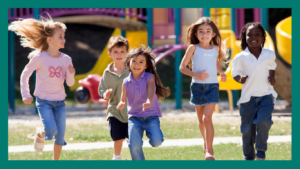
Between ages four and five, children’s bodies become stronger and more coordinated.
Typical physical development for ages four and five:
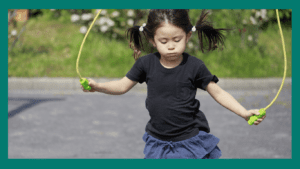
- Improved balance, (hop, skip, stand on one foot)
- Increased stamina (running, climbing, outdoor play – you thought you were tired before!)
- Greater hand strength and coordination (drawing, cutting, early writing)
- Improved self-help skills (dressing, using utensils)
Educator’s Role
Educators move away from assisting with tasks to allow children time to try things on their own and develop confidence. Additionally, educators plan helpful experiences in areas where children need more support:
- daily active play opportunities (playground time, dancing, games);
- fine motor practice (art projects, building toys, puzzles, playdough);
- opportunities to practice independence (zipping jackets, tying shoes), offering help only when needed; and
- predictable routines balancing activity with rest.

For more on the role of educators at Upper Canada Child Care, see Upper Canada Child Care – Our Childcare Programs.
Social Development: Increasing Communication and Cooperation
Kindergarteners are increasingly social, becoming more aware of peers, developing friendships, and beginning to understand group expectations. Play may involve shared roles and rules, e.g. “You be the cook; I’ll take the money”.
Common social development for ages four and five:
- playing cooperatively, turn-taking;
- beginning to problem-solve peer conflicts, with guidance;
- showing interest in friendships, preferred playmates; and
- understanding classroom routines and group rules.
Examples are more powerful than instruction or correction. Four- and five-year-olds look to adults to understand how to respond in each moment.
Strategies to support social growth:
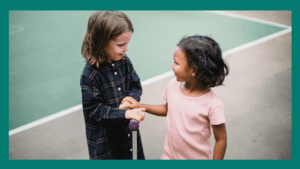
- modeling and practicing social skills (sharing, listening, respectful communication);
- role-playing social scenarios, (e.g. asking to join a game);
- offering language for emotions and problem-solving (e.g. ‘can I have a turn?’”); and
- encouraging participation in group activities like a team sport (it’s cute to watch a group chasing the ball, like a flock of sparrows!)
Expectations and Consequences
Compared to preschoolers, kindergarteners benefit from more explicit conversations about expectations and consequences. Caregivers can support children in navigating social challenges more independently, and expecting children to practice self-regulation skills, not master them.
General kindergarten expectations:
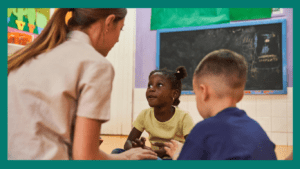
- follow two-step directions (“put your toy away and come to the table”);
- manage personal belongings (coat, backpacks) with minimal help;
- participate in group activities for longer;
- use words to resolve minor conflicts (“please stop,” “can I have a turn?”); and
- understand and follow rules with fewer reminders
Importantly, consequences should never be harsh or punishment. For four- and five-year-olds, consequences are more logical, predictable, and related to their developing sense of responsibility. For example, if a child forgets to clean up, they return to complete the task before moving on. Or, if a conflict with a friend arises, the child is supported to help repair relationship (apology, problem-solving). The point is that children learn about outcomes related to their choices: What happened, why it matters, and what to do differently.
Emotional Development: Building Self-Awareness and Confidence
Emotionally, four- and five-year-olds are learning to recognize, express, and manage their feelings.
Typical emotional development for ages four and five:
- naming basic emotions in themselves and others;
- developing empathy and concern (e.g. “can my friend have a snack too?”)
- increased pride in accomplishments; and
- managing separation from caregivers with growing confidence.
Supporting Confidence
Adults can provide security and safe space to try new things, or cope with challenges by:
- acknowledging and validating feelings (especially in challenging moments);
- teaching simple coping strategies, like deep breathing or taking a break;
- maintaining predictable routines to provide emotional security; and
- encouraging effort rather than perfection to build resilience.
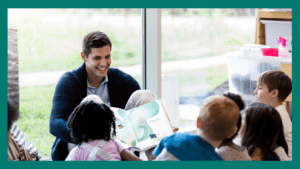
Furthermore, to support the transition from preschool to kindergarten, caregivers can shift from soothing a child’s emotions to teaching skills with the child—helping them learn how to calm themselves and express needs appropriately.
Managing Relationships
Children at this stage often have a wider circle of adults in their lives (like teachers, coaches, and caregivers, alongside family) and are sensitive to adult tone and attitudes. Therefore, speaking respectfully and neutrally about other caregivers helps children feel emotionally secure and confident in their relationships. When expectations align across settings, children feel safer and more able to focus on learning and social connection rather than navigating mixed messages. Moreover, open, respectful communication among adults supports consistency and reduces confusion.

Adapting Caregiving from Preschool to Kindergarten
Whereas preschoolers rely heavily on adult direction, kindergarteners are beginning to manage expectations, routines, and emotions with greater autonomy. Some key adjustments caregivers can make to support children during this time include:
- offering structured choices over direct instructions;
- encouraging problem-solving prior to stepping in;
- supporting responsibility for belongings and simple tasks; and
- communicating expectations clearly and consistently.
Although this transition can feel challenging, it reflects healthy development. When adults trust in children’s abilities, while remaining available for guidance, children flourish.
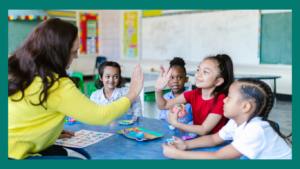
Honoring Individual Development for Children Ages Four and Five
Though milestones provide helpful guidance, they’re not strict timelines. Some children progress in physical skills quickly but take longer socially; others show emotional awareness before fine motor mastery. What matters most is progress, not comparison. Also important is to seek guidance if you have any concerns about your child’s development (see Early child development | ontario.ca).
Final Thoughts
During the kindergarten years of remarkable growth and transformation, caregiving must also evolve to be developmentally supportive. Through understanding development, and adapting caregiving approaches accordingly, adults can create a nurturing environment where children feel confident and capable.